Saturday, April 17, 2010

Are You Ready?

Third Sunday of Easter

I enjoy reading and re-reading John's 21st chapter, I admit it.  And it's not only because Jesus is in charge of cooking for his friends, something I and many others like to do too and something he clearly enjoyed here!  Maybe it's the palpable warmth and confidence we sense in Jesus; he's familiar in word and gesture with Simon Peter and friends, putting them at ease, encouraging them to trust in his word (again) and in their new instincts, their new faith.  Maybe it's the experts fishing all night and catching nothing, yet another sad failure of church leadership (yes, even back then) but presented to us as as an eerily familiar subtext to the deeper story.  Surely, empty nets certainly would distress the fishermen (and even more, their leader Peter who had failed so often and so recently with Jesus!  But their inability to get the job done is now one more opportunity for Jesus.  The little group, responding to his familiar challenge and invitation to trust his word, are again dumbfounded:  their huge catch shows that the kingdom is actually here, that life is abundant rather than scarce, that grace has its own power. 

Maybe it's just this resurrected Christ's easy manner, so friendly and familiar and inviting, not at all shut down by the apostles' initial fear, distrust and reluctance.

But what I've found most moving in these passages also seems terribly needed today, i.e. Jesus' two part private conversation with Simon Peter: 
Simon, do you love me?  three times, each one probing deeper into the heart of a man who was in trouble. 
Lord, you know that I love you -- three positive answers from Peter, the previously self-important, boastful, and violent knucklehead who was now learning true honesty. 
It was enough for Jesus, who then lays on his friend overwhelming, impossible responsibility:  feed my sheep, feed my sheep, feed my lambs.  Peter's love of Jesus (really, Peter's willingness to be fed by Christ's love for him )  clearly counts much more to Jesus than do Peter's sins -- and many they were. 

Is this not the conversation that our Church (and we, its leaders and ministers) could be having with the Lord?  We must know by now that it's not enough to fear for a world that will always tend to destroy itself.  It's not enough to worry and stew in our feelings of failure, guilt, and loss. 

The last part of the gospel seems to me to offer a lesson, but one easily lost to us today  i.e.
when you were younger, you used to dress yourself and go where you wanted; but when you grow old, you will stretch out your hands, and someone else will dress you and lead you where you do not want to go
What does all that mean?  
Commentators caution us to not be satisfied with the following text's explanation concerning Peter's death -- that can't be it.  The "lesson" remains hidden or insignificant only to those who are not experienced enough in life to read it closely and personally, or who themselves are convinced only by some sort of muscular, dominating christianity, despite all what the prophets and the scriptures tell us. 

We do know this about Peter.  He never forgot his broken humanity, whether it was completely misinterpreting Jesus' intentions as his King or soon afterward denying Him completely.  He apparently insisted that his contemporaries not forget his failures too (thus you and I know of them from the Scriptures).  While he continued to get a lot of things wrong -- remember his many arguments with Paul about Christian identity? -- our first leader, Peter was himself now able to be led.   He was both able and willing to listen, to learn, to allow the Spirit and grace into the early Church.  It was no longer about Peter, about his plans, his success, his church "building." It was all about getting the Good News out, and doing so by being good news.  More deeply, his role was now to help others allow the Lord love them, just as Peter had finally done. 

How else could they have found their way?

Thursday, April 15, 2010

Formation in Teruel - an International CM Experience

Teruel. April 12-15, 2010

We three (Juan Julián Catalán - the Provincial, Julio Suescun - visiting from Rome, and I – visiting from Little Rock) arrived here yesterday late afternoon after a quick drive of about 170 km on good roads. For me this excursion was unexpected and I understood at the last minute that I'd be here for most of this week, leaving me in a bit of a panic changing plans, rearranging masses with the Daughters of Charity, alerting the teachers at CRETA (the Theology Center) of my absence, etc.  Of course everyone here responds, "Tranquilo!  Vále!  Venga!" (roughly -- "Relax!...okay, great!....Go-man-go! ...this last one I'm not sure about)   I'm staying flexible after having learned how "spontaneous" CM planning can be, especially here.  Actually, this uptight male-American is only beginning to get the hang of my confreres' concept.  But that's another blog.

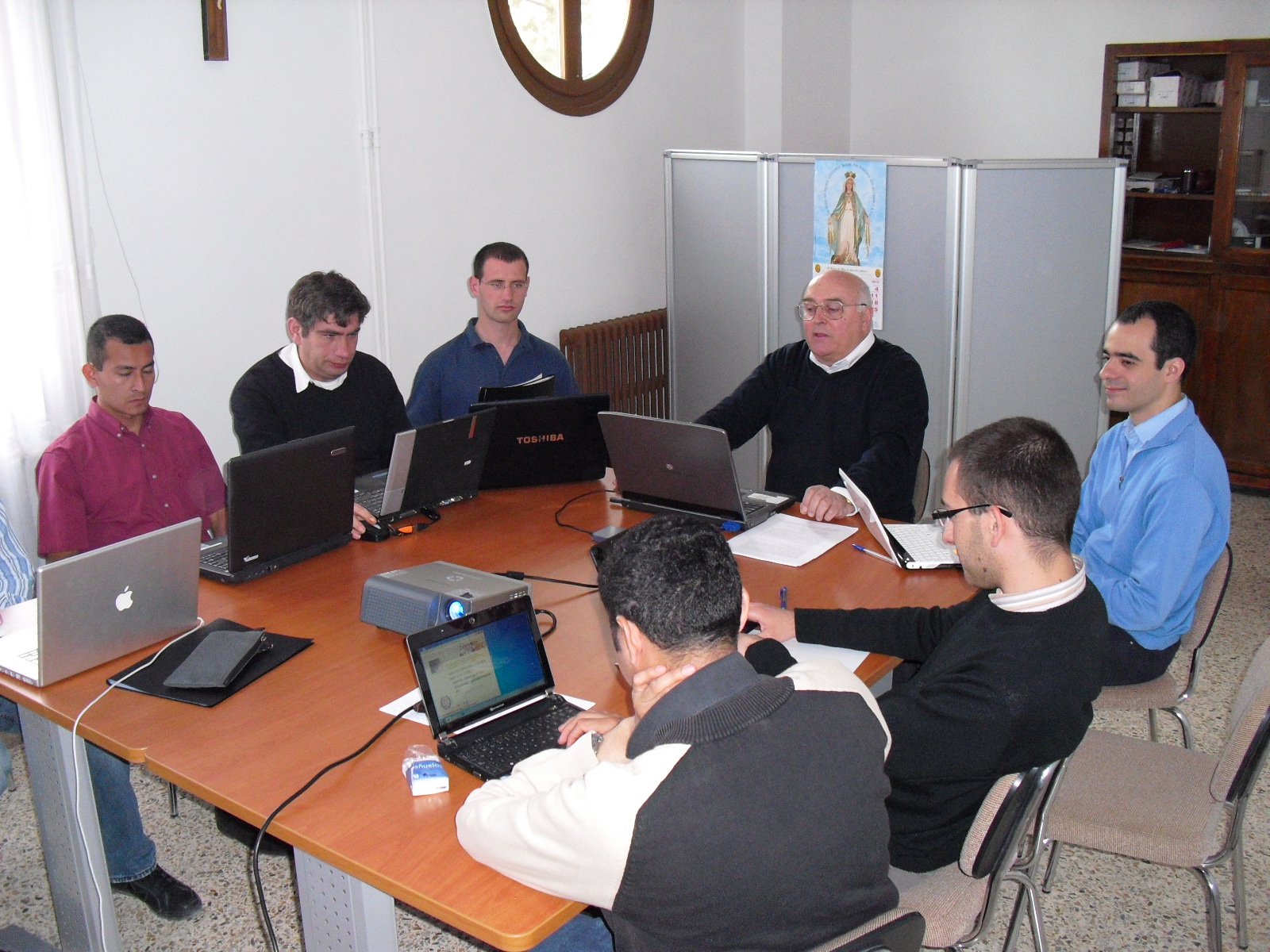
Casa Padres Paúles is a multi-apostolate canonical house (parish, residence, and rooms aplenty, some leased) located across the huge gorge that for five centuries separated our barrio (neighborhood) called En Sanche from the historical town of Teruel.  The confreres simply call it Teruel (pronounced tay-roo-éll).  Today the house hosts nine months of the Internal Seminary, an intensively reflective period of formation and integration into the Congregation of the Mission. It is also an international program supported (remarkably) by many of the European provinces (CEVIM).  Juan Corpus Delgado, Zaragoza Province's previous "Visitor" -- provincial superior -- is Director.  Corpus is well suited to the task; he's an experienced formator, very skilled in spiritual direction, quite articulate (everyone understands his Spanish!), serious when appropriate but very welcoming and a delightfully funny man in Community. Alberto Quaglialori, two and a half years ordained from the Turin (Italy) province, is his young and enthusiastic assistant. There are four other full-time CMs residing this big house (it was Zaragoza Province's Preparatory Seminary in years past) which is attached to the Vincentian parish, Parroquia de La Milagrosa. "Teruel" is one, unified house. Everyone shares meals and participate in daily Eucharist (along with recitation of the Divine Office). The seven (six pictured here a in session on CM saints and beati with Fr. Juan Julián Catalán in the center) seminarians are:

1) Leonel, 33 our Frenchman for the Toulouse Province; 
2) José Alberto, early 28, for the Zaragoza Province. Nicaragua-born but long time resident in Spain;
3) Wilmer Alfredo, 28, for Zaragoza Province, a Honduran farmer;
4) Lorenzo, 35, for the Turin Province, a computer whiz;
5) Lorenzo "the second" – they call him Lorenzino  - 22,  for the Naples Province);
6) Agustín, 22, for the Naples Province); and
7) Enrico, the eldest at 38, for the Turin Province, flautist.

It's easy to notice the variety of talent and depth of previous experience in this group of young men, beginning with language. Most speak at least two languages which they expect to continue learning and using; of course Spanish is essential here in the international internal seminary, but the five non-native Spanish speakers speak it at least as well or better than I do…

Most had already been earning a living before entering the Vincentians. One was a successful professional agronomist for a few years, another made a living designing software and setting up computers, a third is a concert-level flutist – he performed an impromptu duet with our (quite famous) composer and long-time CM resident in Teruel, Jesús Maria Muneta.

My initial impressions? 
In most ways these young-to-middle-aged men would fit in well with the up-and-coming generation of seminarians in the United States: they are enthusiastic about the Church (and the Vincentian's worldwide mission!), are conservative theologically and seem inclined toward a more orderly church structure and more centralized (and respected) church authority.  But they are genuninely committed to Vincentian studies, serious about common prayer and Eucharist, are fun to be with, and are fanatics about futbol (not the real football we have in the States, but that can't be helped) and about sports in general.  Sure, one or two get teary-eyed about Latin, just in case we return to the good ole days ... and, of course they ALL want to learn English. Which means that most of them expect to travel, to see more of the world, to experience more places and things... sooner than later, if possible.

The Internal Seminary is designed specifically for candidates who have already discerned their call to be a Vincentian missioner; there are about four more years of formation in theology before these men can request and be called to ordination. Formation such as this -- not in your own culture and not in your native language would seem, well, more complicated than necessary to some.  Nevertheless, this is not the first international European Internal Seminary and it appears that results have been favorable for this approach and location -- there have been various programs here in Teruel before.  In any case Teruel is a CM acknowledgment that the world and church has changed; so must we along with our formation.

In the United States we have had to undergo similar changes in our culture, but we CMs have been slow to adapt ourselves and our pastoral styles to rapid changes in the socio-cultural make-up of our parishes and of our young. I suspect that we Americans are overly cautious about such matters, perhaps fearing (too much) making mistakes as we haltingly re-learn to reach out to the young and invite them to join us. Perhaps we are reluctant for fear that those same young people we recruit, mentor and form will change us as well...which will most certainly happen!  Personally, I am heartened to see such an upbeat group of young and not so young CMs living and working together, handling their differences of culture, language, work, and disposition with grace and good humor. I’m also no fool; initial formation is an art and can be hard work; choosing the right director, associate, and sponsoring house must all be done with care and ongoing reflection.  Perhaps this Internal Seminary works, in part, because the sponsoring provincial, Juan Julián, and many other CM leaders (i.e. in CEVIM) involved have themselves been formators and, most important, are no strangers to Teruel. 

Indeed, it’s a house I’d love to come back to myself.

dpb

Sunday, April 11, 2010

Scars that Teach

Second Sunday of Easter

I've always had a soft spot for the apostle Thomas, especiallly when vilified by some after they've read John's Gospel account of  "the Doubting Thomas."   Of the twelve, Thomas clearly is a standout apostle  for wanting to go with Jesus to Jerusalem "to die with him," an extraordinary gesture of awareness and comprehension of what was to come, especiallly in this group of mostly rather unaware and non-comprehending followers, the Twelve.  Perhaps I like Thomas because, like many in my generation, I tend to admire scientists who stoutly demand "to see" before believing.  Perhaps it's because Thomas refused to get caught up in the emotion of the moment -- to be too easily swayed by the enthusiasm of those who had claimed to have seen the risen Christ.

But the Gospel of John is first and foremost a theological reflection of a maturing Christian community (some 40-50 years after the Resurrection).  It's reallly not a chronicle of raw facts.  So, I suspect we really can't know exactly (scientifically) what happened those first few days after the Resurrection.  What we do know is how the world began to change after Jesus' Passion, Death and Resurrection ... starting with those rather ordinary, believable disciples. 

John makes a big point of the resurrected Jesus' compassion for His startled, uncomprehending friends and disciples.  It's this new, resurrected Jesus who takes his time in instructing and then eating (breaking bread) with his companions (Emmaus), of calling them by name (Mary Magdalen), and of having Thomas actually probe his scars of torture, crucifixion, death, failure.... Finding their focus and recognizing the Person for what He now was... well, it took time!  Clearly this is not the Jesus they had earlier expected, the one who would vanquish all enemies and come out (along with His followers) smelling like a rose.  It's the same "Son of Man" who really and horribly died, practically alone and reviled by his people who now, somehow and misteriously, has overcome our worst nightmares.  Thomas and the early Church knew something important: the resurrected Christ must have scars, to be believable, not only to Thomas, but to us.

In my world -- as a missionary priest in the Roman Catholic Church -- these days have been difficult with daily news and commentaries about how so much clergy abuse has taken place in our times and how poorly church authorities have attended to the victims and been responsible with our perpetrators throughout the years.  Current news-bytes and conversations (in Europe particularly)  brings me back to 2002 in the United States when, at least to some American Catholics, Church Authority seemed to have completely imploded.  On hearing story after story, first of clergy abuse of children, minors and other vulnerable people, and then how horribly mis-managed these cases had been by our leaders, many of us were scandalized or shocked, some felt betrayed, disalllusioned or even depressed, most of us were angry (blame someone!), and all of us were affected.  True, we were dealing with our shadow, with sin, but those have been very difficult times from which we are still struggling to resurface, hopeful and enthusiastic about our mission in America. 
Here in Spain, historically and culturally a deeply Catholic country, these are tough times for the Church (certainly the same can be said about Ireland and Germany!).  My guess is that, with increased interest (and openess, at least in many sectors of the Catholic Church) these are not sordid tales that will disappear along with the next celebrity's "event."  These are deep wounds on the Body of Christ, almost always on the poor and defenseless young, on those who depended on religious leaders and preachers to keep them safe; they are very deep and will not be forgotten.  The question is not how to protect the Church (and especially our institutions or "systems")  from further scandal by shieing away from speaking the truth; Grace does not come to those who deny the truth about themselves or refuse to learn how to speak about it openly.  Hopefully we are learning how disasterous (publicly) and sinful (morallly) that impulse has been. 

The question is how to heal those wounds. 

As we review the gospels during these weeks, it should become very clear that Jesus wants his chosen disciples to remember his teaching --despite our habitual distraction, dullness and obstinacy.  He wants us to remember  his signs, as well as our intial blindness.  He insists that we tell his story of  passion and death, while remembering our own fears and tendency toward flight.  And only then, it is in our telling of and believing in his Resurrection that we ourselves can be healed.  And all of this, well, for us (just like for the apostles) it takes time and God's grace!   I believe that, like our predecesors, those sinful, forgiven disciples, we too will be ready and eager to share His story with those who so desperately need to hear Good News these days.

Sunday, March 21, 2010

To forgive or not; that is the question


The 5th Sunday of Lent (John 8: 1-11)

Growing up, we absorb an awful lot from family, friends and our culture -- for the most part unconsciously.  Over time these beliefs and inclinations (pre-judgments) understandably have grown deep roots and, contrary to popular psych, rarely do we question or easily change such learnings.  Indeed, we're more likely to defend these positions, consciously or not.  After all it's such “conventional wisdom” that gets us through the day, most of the time.

I suspect that in my own life-lessons there is more American egalitarianism and meritocracy than anything from the Bible; indeed, like our Protestant neighbors, my generation often used the Bible (although more often we the Baltimore Catechism) to “prove” what we believed. Why not? these were sound Christian principles and if we don't know exactly where they came from, they could at least be footnoted in the Bible.

Until it came to forgiveness, that is. Forgiveness seemed one of those “soft doctrines” meant to be taken seriously by only a very few – people like monks, nuns, or imaginary characters in a bedtime story or a Disney movie.  In the real world, self-made, hard-working, mostly-successful people don’t easily forgive; it doesn’t seem right, nor fair. Deep down it may not even feel normal or human – at best we can forgive, but never forget! (whatever that means!) We can even argue that forgiving is ultimately disrespectful to the one who has done the damage. For his own good he should repair the damage, she should feel our pain, they should pay the piper…

While growing up with my brother and three sisters, children of devout Roman Catholics in a little Baptist town in southeast Texas, I learned that each of us is responsible for his or her own life. If we worked hard, were honest and fair, and treated others with respect then we would do well in life.  On the other hand, if we were lazy, made too many mistakes and hurt others, then we would pay with ruined lives and worse – even with eternal punishment. 
I’m not surprised that I remember very few of those many punishments I received while growing up.  For me there's no doubt; I deserved every one of them.  I do have one memory, however, of when I couldn’t have been more than seven or eight years old.  It happened during one of our “family nights” when the Borliks gathered together for fun -- to watch a movie or play cards (I can’t remember which, this time…).  That afternoon I had been caught fighting with my brother Rick and I had hurt him.  As punishment, I was grounded in my room for the night. Fighting with Rick was certainly not an uncommon sin for me, but on this particular occasion I was terribly sorry (probably mostly because of the punishment!)  That night, about midway through the festivities, Mom entered my room to check on me.  I was disconsolate, miserable, crying. She sat down at my side, saying nothing, but put her arm around my shoulder and we sat together for a moment or two.
I could barely speak but mumbled, “I’m sorry…”
She said, “come on out and join the rest of the family.”
And that was that. Forgiveness was my mother shouldering my guilt, inviting me back into the fold… I felt free as a bird.

A memory like that could help see what needs to be seen in this Sunday’s gospel.

Jesus gets himself in trouble again, at least with those who’ve dedicated their lives to bring some order to their homeland. He dares to ignore his own Law and seems to let a condemned criminal (a woman caught in adultery) go free. By what right? Who does he think he is?

No matter how one feels about political or religious leaders (in Jesus’ Palestine these were the Pharisees, Scribes, and others the people respected), the authorities were “right” to point out that an injustice had been done and the guilty woman should pay (no mention of her male co-conspirator, or how they caught her in flagrante, but that’s not the point).

Unexpectedly Jesus responds, profoundly but in silence; instead of pointing  with his finger at the sinner (as society did then and does now...) he begins to write in the sand – perhaps a reference that it is the Lord God who writes the Law in the first place…). Then He turns the tables in two ways: 1) he challenges the accusers to execute “justice” only if they are without sin themselves (who can do that? at least if they're honest and conscious?); 2) he offers the woman a new start, re-newal if she is sorry and accepts forgiveness (she does).  Jesus has re-written the law of "getting what you deserve"  at least the one so many of us have had instilled in our hearts, with the Law of the Father.  Who has the right to do that?  Only someone who can truly side with the guilty and shoulder their guilt, that's who.  Today Jesus simply shows us how it's done.  We Christians should pay attention; we are, after all, his disciples.

What a pity, that, in our so-called Christian society and even in our Catholic communities, such forgiveness hasn't caught on, that it hasn't become the fashion.  It could save our world so much grief!

Monday, March 15, 2010

Al vivir un día en Zaragoza...


One day's life in Zaragoza...

The other day I finally was able to get a phone card to call my Mom, Kathleen, in Grass Valley California.  Since she's very hard of hearing and, at this point in her life, a bit suspicious of callers, I have to walk a gauntlet of sorts, shouting out shared memories, her equivalent of birth dates and social security numbers, all just to assure her that it is indeed "her Dan."

Finally she asked,
“Dan,...where is this Zaragoza place? Is it near Sacamento or is it in Texas?"

“Mom, Zaragoza is on the other side of the world!” I told her. 

That's as good a description as any other, for a modern European city with history going back to Jesus' time (historical name is Caesar Augustus) with it's great co-cathedral devoted to Mary, Mother of Jesus, who, soon after the Resurrection, appeared on a pillar (Santa Maria del Pilar) to encourage the failing apostle Santiago (James), the area's first Cristian evangelizer.  Santiago stayed, of course, and what was once a Roman outpost has been a Christian bulwark for 2,000 years.  Zaragoza unquestionably is booming these days with new high rises and public transporation projects abounding, thanks to (too many?) European Union loans; but it still has plenty of Old World charm. 

It’s been two weeks and two days since flying from Los Angeles to this northern part of Spain and, well… “I’m liking it!” In part it's because all is still new to me and in part because I’m betting that I can learn something worthwhile over the coming months here. More important is that I'm here to live rather than to pass through like some tourist.  Perhaps I'm reacting a bit to eight years of travel for meetings and other Vincentian business - admittedly all important matters, of course!  But I had reached a point of traveler's ennui, finding myself just after arriving at, let’s say, Rome or Paris or Calcutta or (even) New York spending half the time unpacking for the business at hand and the other half packing to be ready for the next place. I was living in a bubble.  No way to travel, really, and certainly no way to live; indeed, most of it seems a blur to me now.

Here, situated for a few months at 9 Las Misiones (the street), Casa Blanca (the neighborhood), Zaragoza (the town), Aragon (the region), España (the country), I wanted to be in no rush learning how just to live – and more important – to live as a Vincentian missioner, with other Vincentian missoners. I suppose that, while writing up my sabbatical proposal, my hope was to rediscover some Vincentian-thing in my life or to metamorphase into a mature (read “wise, aging”) Vincentian – I’m not sure.  I clearly felt that this was my golden opportunity for some kind of push in terms of language and culture. In any case the Provincial House in Zaragoza is a great place to sort out and explore such matters: the men are glad to welcome and include me…as well as to leave me alone when that seems right! And while I’m re-learning how to live, I wanted to improve my Spanish “without getting perfectionist about it…” For this there’s my confreres here, particularly Juan Julián C, the provincial superior (a first-rate educator and avid student of cultures), and other colleagues here who have suggestions. So far so good. I’m finding that there are plenty of people who are happy to help me, if I ask and… if I know what to ask for.

Back to living here. Let me describe it.

¡buenos días!  dormiste bien?

Typically I wake up at 530 am, with or without the alarm clock. Just being awake when it’s still dark outside is surreal enough for me but I’m finding that I need ninety minutes or so just to get going these days! A cup of fresh espresso (yes – the CMs have a machine here!) does wonders. Then, I head outside to start up Juan Julián’s aging and diminutive VW diesel coche and drive through mostly empty streets to the Tres Casitas, one of a dozen Daughters of Charity houses here in Zaragoza, where we celebrate mass and have breakfast. After our prayer together, it’s hard to get away after the requisite lengthy breakfast (mostly light fare: coffee, toast and jam) which is mostly a setting for morning conversation.  It is great fun too, with all of them talking (sometimes shouting) at the same time; a common practice in Spain!  It’s all I can do to keep up. Of course, besides the local gossip, there’s the weather to complain about and food to yearn for: I’m learning recipes and many, many colloquialisms, the latter most likely useless outside of Spain!

By 830 am, after crawling through now  tráfico punto (rush hour), I’m back at our house, parking the coche and rushing out to hike the Avenida La Hispanidad to make classes at the nearby Diocesan seminary, called CRETA (Centro Regional de Estudios Teológicos de Aragón).  Until I return to California toward the end of May I’m auditing six graduate level courses: Church History Middle Ages; Fundamental Theology, Sacramental Theology, Old Testament Prophetic Books; Fundamental Christology; and Patrology (Early Fathers of the Church). Thank God, homework is discretional and there’s no exam for me! These sessions consist mostly of lectures three times a week, some only twice a week. Teaching style ranges from pure lecture (most common) to seminar style, with students charged with preparing presentations for the rest of us along with the professor’s guidance. Instructors are mostly religious and all ordained priests (I think). At least half of the seminarians (studying for dioceses here in Spain) come from Latin America, mostly from Colombia. Interestingly, a good third of the students are laymen and women and also some retirees. I’m quite a rarity, it seems, for being both a priest and from (rich) America to boot!  (Everyone has to try out their English on me, at least once.)  Happily, I also feel quite welcome here.

I’m back at the house by 115 pm or so just in time to sort things out before our big meal (la comida) at 145 pm. The midday Comida is the heavy meal throughout Spain; more importantly, it’s family time and many workers return to work only in the evening, to complete the day. Our comida here always offers soup, salad, lots of vegetables, potatoes or rice or pasta, one or more selections of meat (pork, chicken, lamb are most common) and always some fish. As men often do, I suppose, we wolf all this down in 30 minutes or less, leaving conversation to the end. Then we all head up to the Community Room to watch the news, read newspapers, and drink espressos or tea…for about 40 minutes.

I try to get a 30 minute power-nap before heading out again, this time to the local University (Universidad de Zaragoza) where I’m finishing up my one and only Spanish language course (probably). The program is called ELE, Cursos de Español para Extranjeros (“Spanish for foreigners”).  It has been for me, at best, a needed grammatical review. One of two men in our class of a dozen, I could easily pass for everybody else’s abuelíto (granddad), including the instructors’!

After three hours of this with two short pausas (breaks) we all rush out of the building into a pitch black and quiet outside. I hike back to our house (20 minutes or so of very brisk walking, each direction) just in time for our 900 pm supper (la Cena) which usually consists of salad, soup, leftovers from the Comida (and, almost always some form of fish), followed by our evening Community Room recreation with coffee/tea and brandy afterwards. This time is usually good for an hour since the most popular comedy programs are on! By 1030 or so it’s been a long day, and I’ve yet to have any problems falling asleep!

¡hasta mañana!

Wednesday, March 10, 2010

A Comer Rancho!

I suppose my first posting on the impact of this language/cultural experience would have to do with food -- for me the universal language! But this particular food is linked with an important day in Zaragoza, el Cincomarzada, the fifth of March.  My first clue as to March 5th's significance was that our evening language classes at the University of Zaragoza were beginning early and ending late and were not according to the posted schedule.  Instead, thirty thirty minutes had been added to each day to make up for losing one class day due to a major festivo (a public holiday when all businesses close down and people take to the streets). Why? what is the big occasion? Well, the details appear to be contraversial and what actually happened is debated every year -- depending on who you are, of course, Cincomarzada is a great occasion for all citizens of Zaragoza (not applicable to the rest of Spain).  I found a blog that gets into the matter in detail, of course en castellano!  http://historiantes.blogspot.com/2007/03/la-cincomarzada-en-zaragoza-una.html

More important is what you do on this day: you eat.  With friends and family...and usually in the park or outside, and most important -- you eat RANCHO!

RANCHO: una RECETA (recipe)


 INGREDIENTES

  • 1 cebolla picadita, según la cantidad (an onion, chopped -- depending on how many you're cooking for)
  • 1 tomate picadita (a tomato or two, again depending on how many)
  • ajo, segun tu gusto (garlic -- you've GOT to have garlic, right?)
  • algo de acelga (kale -- for some reason, very popular in these parts)
  • unas patatas, según la cantidad (some potatoes, quartered)
  • arroz, poquito (a little rice, more for the look of it, really)

(all the above is only to season what makes this "RANCHO", below)

  •  conejo (rabbit -- best to cut in quarters or more)
  • costillas de cerdo (spareribs)
  • ternasco (veal)
  • longaniza (a special sausage, red, long, and narrow, nicely seasoned)
  • caracoles (snails -- yes, I couldn't find any of these in my portion but I'm told they're essential...)
  • bacon (of course)
  • sal (salt -- only a little on top of the meat before cooking)

*****************

MODO DE HACER (how to cook)

FREIR la cebolloa, tomate, y luego el ajo. (fry the onion, tomate and later add the garlic)

AÑADIR (add)

* toda la carne (all the fresh meat)
* longaniza a trozitos (the longaniza, cut into inch-long pieces)
* las patatas a trozeada (the potatoes, quartered or so)

REHOGAR TODO (stir all of this with with a big wooden spoon, browning the meat)

A CONTINUACIÓN, SE LA ECHA AGUA (then add water, just barely covering the meat)

TIENE QUE HERVIR Y DESPUES, SE SIRVE (it all needs to slow boil - simmer - for 20 minutes or so. then dig in!

Sunday, February 28, 2010

Seeing is Believing

KaPow!!  I suppose that's what Lent feels like to those of us who haven't been looking forward to it,  And, frankly, who does?  I mean, really.  Not me.  Let's face it -- Lent never really has fit into our lifestyles since modern times.

Clearly, Lent is meant to challenge productive, busy people -- which more and more of us are these days.  Lent is a warning to DO less and REFLECT more.  Lent makes now the time to LET GO of things and (better) to SHARE the best of our things with those who really need them, rather than accumulate and protect them for ourselves and loved ones.  And all this prayer, generosity, and personal discipline really should be done in PRIVATE anyway, so where's the fun in that? 

It's no surprise that Lent feels counter-cultural, even counter-intuitive.  For those who take pride in their independence,  free spirit, and success, Lent is the time to acknowledge just how llittle value these passing things have; just give them a little time and all such things are forgotten.  Pretty bleak agenda, or so Lent seems at first.

The truth is, of course, not bleak at all, at least not if we follow the Christian Scriptures during these 40 days.  No matter who were are or what we've done -- so our Tradition admonishes us -- NOW is the time to know how each of us is precious, loved, and given the chance of a lifetime to cash in on this truth.  All we have have to do is SEE it.  Easier said than done, seeing/hearing the truth (as Jesus constantly bemoaned with his own friends and disciples!). 

The fact is (and for me, a wonderful fact) most of us can use up a lot of lifetime just learning to SEE and to HEAR the Good News.  It took Peter his own humiliating betrayal of his Master to know how to recognize and welcome Jesus' healing forgiveness-- making this the hallmark of his own preaching.  Vincent de Paul struggled until middle age before beginning to grasp that his own salvation was tied to God's plan to love, care for, and evangelize the poor.  Long delays and endless missteps on our part will never stop the News from being good nor true.  Indeed, "getting" the Good News happens in God's time and is God's grace (gift) at work in us.

But when it does take root in us, the Good News never leaves, but often will make us uncomfortable and hopefully contagious.  We kind of lose our taste for the things we had thought mattered, as we now yearn for that restored kingdom described both in Jesus' teachings and His life -- the pearl of great price, the hidden treasure in the field, the lost coin, the inappropriately forgiving father, the peasant-rabbi so willing to suffer just to show his friends how to live in freedom...  We do become restless -- thanks to Lent -- which is what most of us have felt anyway, deep inside.  (Caution:  anyone ruined by God's saving grace makes a poor celebrity!)

And Lent's nicest touch?  Well, once we have had the chance to acknowledge that, as disciples go, we are only beginners, we can drop any pretence of creating our own salvation.