Saturday, May 4, 2013

Final Eucharist for Heritage 2013


Happy St. Joseph Feast Day , Bonne Fête !
At this, our final Eucharist together, we have many reasons to be grateful to God!  Why?  First, as we hear proclaimed in our Gospel today, you and I are nothing less than branches of the vine of Jesus Himself –His life runs through our veins – so that wonderful things can happen in our own times just as it did for Paul, Barnabas and those first evangelizers in the first reading.  My brothers, let us never forget that you and I are so special, so loved by God!  Besides having been given the great gift of life (our first taste of mystery!), each of us has been given our faith and identity through Baptism, and, as Vincentians, our special calling as missioners to follow Jesus Christ, Evangelizer of the Poor.  And we have credible models of what our own lives can mean for others - - first in our spiritual father Vincent de Paul, whose experience-rich 80 year journey brought him face-to-face with God through the very people he had at first endeavored to leave behind.  And today we remember Joseph, a faithful Israelite yet quiet and fearless in his obedience to God's voice in his life and his trust of Mary, even when it went against his religious instincts. Finally, today we express our gratitude for four weeks of Vincentian Heritage together, a pilgrimage together as many of you have noted.  And clearly a gift from God and our Congregation, to nurture and refresh us, but even more, to encourage and challenge us.
Chapel picture_Heritage 2013 During these four weeks we have experienced a CIF "formation program" designed for Vincentians who have many years of life experience.  And whether  or not we cherish those long ago memories of seminary days, CIF has been clearly a different kind of formation experience.
Like the young, ambitious Vincent, we spent our early formative years concerned with personal success, gaining knowledge, developing skills for pastoral ministry, becoming excellent priests and effective missioners.   But as appropriate and necessary as that time in our lives was, CIF is different and meant to be so.  Instead of acquiring new skills and concepts, we have tried to deepen our understanding of that call and identity we’ve committed to for years.  Instead of competing for good grades and earning degrees, we have allowed ourselves to stumble a bit, to struggle to listen when it may not have been easy, to share time and life with our brothers from other provinces, languages and cultures, to be in someone else’s world.  It's likely that we felt uncomfortable or uncertain here in Paris, as strangers in a strange land, but these experiences can also open us to the reality "away from the center," to those people and realities that, as busy pastoral workers or educators, we tend to not see and appreciate in our own more comfortable cultures.  I hope so.
Years ago, Fr Hugh O’Donnell described CIF as “moving forward to basics.”  I think this means that we should be deeply open to who we are called to be, and to our life-companion, the true, living God whom we tend not to notice in our busy lives, but who seems to be always pushing and pulling us where He would like us to go.  Even after years of experience and ministry, we know we have stumbling blocks – such as being tempted to gaze backwards – to our accomplishments (or our failures), to keep repeating the same patterns and struggles we had as young men, or to be frightened of aging, of declining health, of becoming “less important” in the eyes of others.   But instead of feeling that we must continue to fight same old battles in our lives, perhaps we can better see how our future as seasoned sons of Vincent could be truly satisfying and even bright : Why not "give ourselves away , completely" to others, why not gratefully receive more and be more willing to listen than  be limited to deciding what must be given, and being in charge?  Why not explore new reasons for hope as we age, rather than slide into self-preoccupation or even cynicism and despair ?  Our father Vincent is such a good model for us as we become more seasoned !
Thank you for your willingness to live and work with us, with each other.  Let us continue to pray for each other, hoping that our lives be marked more and more by the Life coming from that Great Vine that we have helped to form, so that we produce even more fruit as mature branches!
dpb, CIF 2013

Sunday, February 10, 2013

January Days Past...


In Paris, from mid-November through January it seems as if we’ve suffered through ever darker, cloudier, colder days, which may account for my dour mood these days.   This is a dark season, short-days and long nights, cold and colder temperatures, sleeting when it’s not raining…
Paris by Night 1This "season of shadows" is better suited to staying inside seeking warmth and light.  In fact, any little bit of light (even if artificial) goes a long way!  With Christmas still a fresh memory, only a week ago we celebrated the “Feast of Lights,” the ancient feast of the Purification; soon we Christians embark on our 40 days journey towards the great mystery of life, death, and resurrection of our Lord.  Yes, at our best, this is what followers of Jesus do – look for the light!
Street-Sweeper-6-a.m.-ParisBut, assuming that at times we all do struggle to discover the hidden light hidden in darkness, what is it like to think, to reflect as a Christian today (i.e. critically, consciously, as a follower of Jesus)?  Such a person might be better able to see, judge, and act (ver, juzgar, actuar) just as Vincent de Paul clearly did in his own time (arguably, a very dark time indeed!)?  Is this kind of reflecting helpful or even realistic, or is it just another kind of escapism, a flight from our dark, shadowy times?
In this, our fifth (and last) “ordinary Times” Sunday before Lent begins, there may some indications for Christians on what to look for and “how to be disciples”, if we are to stay with the One we want to follow.
Gospel (Luke 5:1-11) :
the-miraculous-draught-of-fishesJesus was standing one day by the Lake of Gennesaret, with the crowd pressing round him listening to the word of God, when he caught sight of two boats close to the bank. The fishermen had gone out of them and were washing their nets. He got into one of the boats – it was Simon’s – and asked him to put out a little from the shore. Then he sat down and taught the crowds from the boat.  When he had finished speaking he said to Simon, ‘Put out into deep water and pay out your nets for a catch.’ ‘Master,’ Simon replied, ‘we worked hard all night long and caught nothing, but if you say so, I will pay out the nets.’ And when they had done this they netted such a huge number of fish that their nets began to tear, so they signaled to their companions in the other boat to come and help them; when these came, they filled the two boats to sinking point.   When Simon Peter saw this he fell at the knees of Jesus saying, ‘Leave me, Lord; I am a sinful man.’ For he and all his companions were completely overcome by the catch they had made; so also were James and John, sons of Zebedee, who were Simon’s partners. But Jesus said to Simon, ‘Do not be afraid; from now on it is men you will catch.’ Then, bringing their boats back to land, they left everything and followed him.
Peter and his companions, "busy with their nets", were likely mildly interested in what Jesus had to say but suffered from the illusion that they were not his “flock” i.e. those who made up the throngs of this new wonder-worker’s listeners.  However when Jesus asked to use their boat in order to teach more effectively (and only that!) they complied –  it was but a small gesture of hospitality.  Then when Jesus asked Peter to “put out into deep water and pay out your nets for a catch,” he was now asking for an act of faith from professionals who knew better.  Surprisingly, Peter agreed and, during that momentary lapse of incredulity, was “caught” himself!  Along with some of his companions he recognized his own hunger and thirst for what Jesus promised and immediately they agreed to leave all that they had known to follow Jesus.  This seems a rocky beginning for what our Church was meant to be!  Still, Jesus’ invitation then (and now?) was simply to decide how to live then and there, a choice based neither out of fear of God, nor of shame in oneself, but rather on finally “seeing” God’s actual work in us and around us.  We Christians were always meant to be people of miracles, i.e. people of faith.
Well, it’s one thing to grasp this truth from time to time during the liturgical season; it’s quite another to develop and nurture the habit of thinking, judging, and acting like Jesus’ followers or like the “Jesus-images” we try be, such as Vincent de Paul, Louise de Marillac, and (thankfully) many, many other heroes, heroines, and saints.  Where do we begin?  particularly in a world so seemingly battered by rapid change, mass migrations, a growing gulf between the haves and the have-nots, random violence, and on and on?
DSC00241
Kenya Vincentian Family: CM priests, seminarians, and DC sisters and candidates discuss case studies.
Priests, Seminarians, Daughters work out Case-Studies for Intercultural living
Perhaps we can learn where to start, such as in our own lives and neighborhoods.  For that is where we live, where we most affect and are affected by others.  Indeed, this was the starting point for a mixed-group of the East-Africa Vincentian Family members gathered in Nairobi, January 25-26.  In offering one CIF module (of many) developed around "the Signs of the the Times and Perpetual Renewal," I was able extend our program beyond our usual locations in France.  So, instead of celebrating our Founders’ Day with a day of rest and recreation, the Kenyan Vincentian Family prayed, listened, studied, shared in groups, even did some writing.  The topics were intercultural communication and critical, pastoral reflection; the theme “Be-friending Diversity.”
DSC00233
Over 95 Vincentian Family East Africa members at Nairobi workshop.
One could hardly think of a better “laboratory” than this group – 95+ men, women, professionals, students, each representing one or more ethnic groups: African tribes, European and American cultures, older and younger generations… but all trying to live and work together harmoniously and effectively!
DSC00231
Fr. Dan Paul Borlik, CM facilitating. 
Fr. Dan Borlik guides the workshop
Who can tell where such efforts and good may end up?  It is difficult enough to grasp how so much of today’s violence is born out of  (often unconscious) misunderstanding, cultural-religious conflict, deeply felt historical wounds – and so much of this at work in us without our knowing or wanting it!  If grasping that cultural diversity is challenging enough, it is still not enough – it takes years of effort (and many setbacks) to develop new "skill-sets" for communicating with and living with people from other countries, cultures, language groups, politics… in ways that are gradually marked by mutual respect and shared purposes, even love.  However, what better group to face these challenges than those who already have vowed to "follow Jesus Christ, evangelizer of the poor."
Meanwhile, we can (and do) always hope that, like Peter and his companions, we may have taken the first of many more steps of putting our lives in the hands of the One we trust the most!  And, perhaps, already sensing some new light in our sometimes shadowy existence.
dpb cm / 10 février 2,013

Wednesday, December 19, 2012

Joyeux Noël de Paris !

Mid-December at the Maison Mère

There are pending projects on my desk but, given the season, I suppose all that can wait…

Early November found me marking the first year’s anniversary of my appointment to CIF (Centre de Formation Vincent de Paul, Paris) – has it been that long?!  Even though living in France still seems a bit strange to me, even surreal (it doesn’t feel like “home,” at least not yet), I do feel grateful to be residing here at our Maison Mère, quatre-vignt-quinze, Rue de Sèvres, sixième arrondissement – it’s practically in the center of this beautiful “City of Lights.”

For nearly a month now the many corridors in this rambling, large house have been eerily quiet.  Perhaps it’s our latitude – it’s so dark now, lasting long before we gather for evening vespers until long after we rise in the morning….  In fact, the darkness of winter seems to have slowed down everything – the multiple construction sites in and around our building complex continue, but they seem to start later and end earlier.  Public activities within the house – Vincentian family meetings, neighborhood groups, etc. are few these days.  Many of our resident confrere priests have left for the next two weeks, some to be with their families, but most to visit our mission houses (rural France) there to help out with the sacraments during this busy and popular season. 

It’s rainy, gray and chilly most of December in Paris, but in the now darker evenings the streets are even more populated than usual:  couples arm-in-arm, clusters of students, young families often with baby carriages, all out for the lights and sights.  During my evening walks, despite the cold, I tend to stay out later now, watching the people and enjoying this picturesque place.  But often enough – perhaps because of the season, I’ll find myself drifting, playing back times and places past, wondering about family and friends now far away, sprinkled throughout the Americas or Europe, India, Africa – what they are doing? how are they? what might these last days of Advent mean to them? 

When the angels went away from them to heaven, the shepherds said to one another, "Let us go, then, to Bethlehem to see this thing that has taken place, which the Lord has made known to us." So they went in haste and found Mary and Joseph, and the infant lying in the manger. When they saw this, they made known the message that had been told them about this child.  All who heard it were amazed by what had been told them by the shepherds. And Mary kept all these things, reflecting on them in her heart. Then the shepherds returned, glorifying and praising God for all they had heard and seen, just as it had been told to them. [Luke 2:15-20]

As a child growing up along with my brother and sisters, in different times and with, what seems now, more imagination, I loved setting up the Nativity scene (crèche) in our family room, indeed, even a few others in our bedrooms.  I suppose that there was the fun of collecting figurines, some of which were quite detailed and unusual and, of course, hordes of animals, adding more and more of them each year – but it seemed that we mostly enjoyed sitting quietly, just watching the scene…  In the end it was all about imagining ourselves right there with Joseph, Mary, the newborn Jesus and that yearly increasing retinue of farm animals, baby Jesus fans and visitors…  What really had it been like to be there, to know who this baby was?  Was it not absolutely marvelous?!  To simple, open children like ourselves, the scandal and the absurdity of God being born under such poor circumstances had not yet registered; this was about our own desire to be included, to be there with the baby Jesus and His parents and yes, with all those friendly animals!  Our contemplation was a joyful longing.

Notably, even for that first Christmas, despite so many prophecies and all those angels. only a very few people showed up – a few land-less shepherds, eventually some outsiders, all foreigners.  Perhaps even then, many people were just too busy with their lives, too worried about “urgent matters” to have time for such unexpected mystery.  Are we so different two thousand years later?  If our beliefs were to reflect headlines today they would mirror little more meaning than a growing sense of dread.  That would be sad indeed, since we’d be risking never acknowledging or even noticing “God-among-us.”  Yet that’s what we Christians believe and that is why we celebrate this feast.  Even if we continue thinking of Him as hidden, God lives on!  God loves us too much to abandon us to ourselves.

May each of us experience for ourselves this contagious excitement of Christmas, the marvel of God’s own presence among us, His healing friendship, His confidence in us – and pass it on to others!


dpb

Sunday, January 22, 2012

Fisherman and Sinner Both?


The gospel (Mark 1: 14-20) on this third Sunday in ordinary time, has us trying to catch up with Jesus. He’s launched his mission, announcing that the Kingdom IS here (same phrases as the now-imprisoned John the Baptizer had used), his tone immediate and urgent.  Then he invites strikingly ordinary fishermen to follow him on this extraordinary journey. 

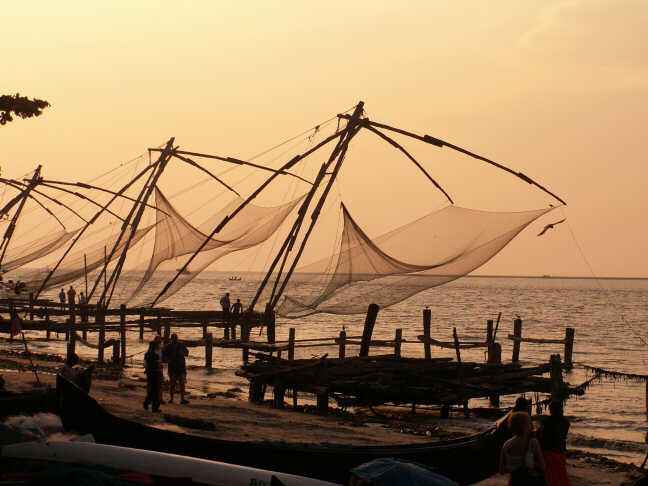
Fishing on a lake in Kerala, India
I’ve often thought that Simon, Andrew, the Zebedee boys initially must have felt that their lives were on the way up, that they had won the lottery.  Something powerful and deeply felt had motivated their decision to “leave their nets.”  From this moment on they could no longer worry about their lives and day-to-day business.  Now with Jesus, they were to be about bringing Good News and healing others… who, to them, before this event, had been strangers perhaps even enemies.  These common fishermen were beginning a journey that would eventually end in their transformation into peculiarly free (and even dangerous) people of the Kingdom. 

It may often surprise – and reassure – us when we notice just whom God calls to do special things in the world of the Bible:  reluctant, complaining prophets like Amos, Jonah and Jeremiah, inexperienced youngsters like David – the boy who would be Israel’s greatest king, Daniel – alien, slave, teenage-seer, and Mary – the maiden who could give an unqualified “yes” to God.  And in today’s gospel… a remarkably unremarkable collection of fishermen’s sons.  Still, I’ve often wondered what compelled them to leave their nets, their places in the world, their responsibilities, their comfort-zones… to follow after a relative nobody.   Jesus of Nazareth was just beginning his work and… well, 30 years is a long time to not be known for anything.  Why take the risk for such an uncertain, “unlikely” reign of God, such as what Jesus was describing!  It appears that, along with such calls from God there always comes the grace to respond...deeply, fully, faithfully.


This Sunday may also have us wondering about how you and I respond to Christ’s call and what is it that we really, deeply desire – not a bad thing at all.  People of the Gospel should never forget how to look forward…to the Kingdom.  Especially today in our youth-obsessed western culture that would have us “yearning backwards” i.e. envying others’ good looks for fear that we’ve lost our own, desperately holding on to some great (if momentary) moment in music, sports, politics, or just endlessly hungry to feel  acknowledged, noticed… we may someday discover that we’ve spent a lifetime leaping from one lily pad to another in our search for happiness… 

Meanwhile, in today’s scriptures, these first “chosen” are described as nothing more than fishermen, pêcheurs in my new language.  In French there’s a play on words here, not lost on the faithful I’ve spoken with.  At each Eucharist we ask God (numerous times, in fact) to forgive us for being “pecheurs  (sinners), yet’s there’s no doubt that it’s essential for each of us to answer His call to to be “pêcheurs” (fishers) – the two words are proounced exactly the same, my friends smilingly agree.

And so, we baptized (also pretty ordinary, right?) are called in the same way – to follow (i.e. to learn from Jesus in transit with Him) and to announce, to heal, to offer hope.   It seems essential that, in order for us to hang in there with the Lord to complete His mission, we have to learn to know ourselves as He does…enough to neither be shocked to know we are always sinners in need of healing nor perplexed by His complete confidence in us as His evangelizers of others.


Email:

Postal Address:
95, rue de Sevres
75006, Paris
France

Saturday, January 7, 2012

Bonne journée! One day in my life...ici à Vichy

Bienvenu à un jour chez Vichy!

The trouble with being busy is that when one finally does take the time to reflect, the first feeling may be regret for not having slowed down enough to even notice, much less be grateful for one’s life.  December has come and gone.  It’s already Saturday morning, January 7th.  Those precious weeks of Advent and Christmas, have left me breathless -- there must have been moments that were difficult and tedious, others enjoyable, delightful or amusing.  But all I can remember today are a few thoughts and feelings from what now has become a blur of events and images.  It is always possible, however, to piece together what daily life has been like, here in Vichy, for this not-so-typical student of the French language.


Mornings are quiet at our Maison du Missionnaire in Vichy, since we don’t really see each other until the midday meal.  I begin the process of “getting up” around 5:20 am, when the first of my alarms sounds off.  It takes awhile to get moving these days, but after some 30 minutes of simple calisthenics, getting cleaned up and dressed, a gulp or two of strong French coffee, I’m ready for daily prayer.  Praying by myself in French (it is still for me  “someone else’s language”) can be a personal struggle as I self-consciously recite out loud the words of the psalms, the liturgy of the Mass, hoping one day to “get it right.”  Still, the effort and routine, although occasionally tedious, seems more than worth it during those moments of connection with the Lord and concern for the community.

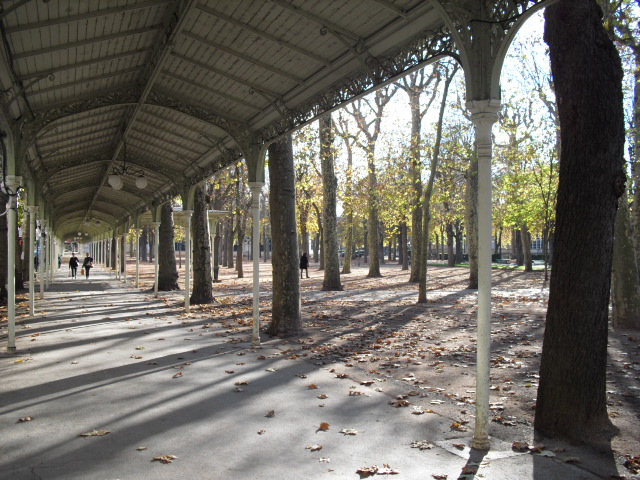
Through the neighboring Parc des Sources (trottoir couvert)
There’s barely enough time for another coffee and a brioche or fruit before I’m launching myself out the front entrance of the Maison for the 15-minute journey to what must be Vichy’s largest private enterprise, le CAVILAM.  Much smaller, cleaner and “manageable” than Paris, Vichy can be delightful – even restful – to stroll through with it’s 18th century covered walks, ubiquitous parks and plazas and intersecting alleyways. Unfortunately,  I have little time for all that first thing in the mornings, as I half-march / half-jog through alleyways and across streets to arrive on time. 

On most mornings classes commence at 8:45 and can be in a variety of settings – sometimes a laboratory with computers and headsets but most often in a traditional classroom with narrow tables and chairs arranged in a U to face the instructor.  During their "high season" between May and September, the school expands to other buildings throughout that section of Vichy to accommodate as many as 1,500 or more students during the summer months.  These days, however, there’s little more than a skeleton crew of instructors and administrators for the 50-75 students attending classes.  Unlike my experience of language study in Guatemala which was commonly one-on-one, here a typical class ranges in number from six to sixteen.  Much of our work, however, consists of practicing conversations in pairs or small groups; the instructor keeps the process going, clarifying the tasks or drills, correcting mistakes, encouraging, setting the pace sort of like a high-school sports coach.  Our classes run for 90 minutes straight, each followed by a 15 minute pause for coffee and a breath of fresh air (or cigarette for a suprising number of my classmates).  There’s time for two such sessions each morning, then a two-hour break for the hike and hot lunch back at the Maison and hike back to le CAVILAM, and then another 90 minutes in the afternoon.  After five such workdays you can imagine how ready we are for a break; on Friday afternoons one hears plenty of enthusiastic “Bon Weekend!” as students and teachers rush away to their homes.  In addition to the class routine there are plenty of optional events, cultural trips, social gatherings during the evenings and weekends.

Our general neighborhood around la Maison du Missionnaire.
By 4:15 pm I’ll be back in the neighborhood, at our residence, our Vincentian Maison du Missionnaire.  There’s always time enough to complete homework for the next day classes but what I enjoy most are the meals – lunch and supper – with the confrères and the residents here.  We are a smallish group now with a total of six for the rest of this winter (the five-story house could accomodate 30 guests) but conversations can get lively as stories abound about Madagascar (one Vincentian here is a native Malagash, another has been a 30-year plus missionary there) or local church politics, or – my favorite -- how to properly prepare any one of seemingly countless French dishes…

After supper I’ll watch the televised news (l’information, they call it here), along with Père Roland Pécoul, our most senior Vincentian resident.  Aided by my I-Pad’s Larousse dictionnaire along with the program’s subtitles, I can usually follow what’s happening – at least in France.  Then finally I return upstairs, to complete our little homework assignments (devoirs), or to study French using free Internet sites or even YouTube, or to communicate with friends by SKYPE or email.  

Sometimes such open-ended study can be quite enjoyable!  Lately I've found a few chansons françaises that are more than worth the effort.  Try copying and pasting into your browser the link just below this paragraph -- it's a YouTube site with the song's lyrics of one of my favorites.  The title is  Je suis malade.  It was written by the popular French singer-songwriter Serge Lama and sung by Belgian-born Canadian resident, Lara Fabian.  Elle est fantastique! 


http://www.youtube.com/watch?v=bIIL5p7_WKk    

Evenings seem too brief for me with so much that one could do to use the time...  But I’m asleep by 11:30 or so on most nights.

All in all, I find language study a demanding experience and often I am sorely tempted to do something else… anything else.  It’s also worrisome to realize that after the immersion studies here (12 weeks) I’ll be communicating at the level of a French toddler.  Still, on those occasions when the fog clears a bit and I can actually grasp the meaning of a conversation and can successfully express an idea, the labor certainly has its rewards.  Voilà!  … yet another new world of peoples, culture and faith begins to open its doors, and… for me, life becomes all the more rich and fascinating.

dpb

Sunday, November 13, 2011

Remembering Paul J. Borlik (+2006)


On November 9, 2006 Paul J. Borlik died in the dark, early hours of morning at his Grass Valley, California home.  It was not an easy passing.  He had gotten sicker, weaker, less able to move about; remaining in his own house may have been the only convenience and comfort he enjoyed during those last two months or so of hospice care. 

Ensign Paul Borlik, during WWII, around 1942
 So busy was I preparing for this particular journey (from Paris to Vichy) that I almost forgot the anniversary of my Pop’s death.   Just thinking on you, dear Pop… I’ve always respected and loved you as my father.  It’s more recently that I’ve come to understand and love you as a man.

It’s been five years now and I still relish the memory of this man’s unique characteristics as a person, his accomplishments, his simple manner, contagious humor, and so on.  But I’ll probably remember him even more fondly for his foibles!  He was a master of modern day “lament.”  Many complaints were understandable – he was terribly disgusted with the direction eventually taken by television broadcasting, professional sports, news media – all his former profession.  He could get moody and distant.  I know too that Pop was often down on himself, maybe disappointed with his own life in a way that only men can be.  More recently I find myself remembering so many people who over the years tended to gather next to and around him.  Despite the fact that Pop may have felt himself to be terribly shy and uncomfortable in his own skin, a lot of people (especially men) seemed quite at ease with him.  Before and after the funeral some of them spoke to me of how grateful they were to have even known Pop at all.  I used to wonder…what did they see?

I do recall an event, back in the late 1950’s, that for a couple weeks or so transformed our reserved, shy Dad into an unstoppable powerhouse of ideas, enthusiasm…and wonder.  He told us later that, because he had lost all appetite for food and worried that something was terribly wrong, he felt he had to consult with his doctor and parish priest. They were equally mystified but wise enough to prescribe patience, to just live through it, the doctor genially adding “maybe you’ll lose some of those extra pounds!”   

It seemed that suddenly and for no particular reason Pop had fallen in love with life – his own life.  He was overwhelmed with joy and new insights about existence, incessantly sharing about it in every single conversation with neighbors, co-workers, his wife and little children, pretty much everyone – especially with the Lord (from then on he seemed most himself in the presence of the tabernacle). 

Today I could describe it only as mystical union. 

Richard Rohr and many others speak often of these things, especially in the context of later life.  These mystical moments are experiences of enlargement and connectedness or union. You become suddenly a bigger person -- you no longer feel the need to condemn, exclude, divide or separate.  Interestingly these moments don’t often fit well with our faith-life in the sense that (unfortunately) much of our early “religious experience” placed us on a private path of perfection, something which none of us could achieve.   If you’re lucky (or “graced”) you’ll eventually find that the path of union is different than the path of perfection.

This kind of "perfection" seems to say that by pure effort or by knowing more things I can achieve wholeness.  But it’s also being separate from God, from anyone else, or from connection to the whole. It appeals to deeply/cultually-rooted individualism and our ego.  Maybe too much Western Christian history has been driven by such “private perfection” sending us on a self-defeating course marked by endless competition, win-lose thinking, conflicts and wars.  In any case, as a priest, it no longer surprises me that many people just give up—even many clergy and religious—when they see that this drive to perfecting my/our world just  isn’t working. Too many of us end up practical agnostics or practical atheists, perhaps staying faithful to form, repeating the “right” words and going to church, but there is no longer the inner desire and expectation that is possible with the path of union. Rohr says that it’s not mysticism that defeats the soul; it’s moralism that does.

Anyway, Pop’s shangrila (as he liked to call it) lasted for a couple weeks or so and eventually he “landed right back in the dirt.”  He never forgot that time though and, even if he couldn’t explain or describe it very well, Pop was always deeply grateful for it. 

We children tend to be hard on our parents, especially during our adolescence.  Our genetic ties might like a burden at times.   Eventually, though, we might be grateful to discover that those same parents’ gifts and deficits continue somehow in us.  For my part, I do hope so.

dpb

Friday, November 11, 2011

Vichy, France: getting ready for school (again)


Maison du Missionnaire, Vichy
After a rather smooth and comfortable 3 hour train ride from Paris (Gare de Lyons) to Vichy I am adjusting to a life quite different than what I left at our Maison Mère, a house and location literally in the middle of things in Paris.  

The Vincentians of the Province of Toulouse sponsor their Maison du Missionnaire (Missionary House) as a comfortable and welcoming house of studies for confrères, seminarians, and other men and women religious who are studying French.  Founded in the early 1920's by Père Henri Watthé, C.M. for ailing missionaries (he himself had ministered for years in China), the Maison du Missionnaire has a long and interesting history and even its own Wikipedia article.

Père Aimé Goliet and Père Blaìse Lalarivony

Happily the superior, Père Aimé Goliet Bernard and the resident missionary, Père Jean-Eudes Blaíse Lalarivony are remarkably welcoming and compassionate Vincentians – and love to talk!  And to make the house even more true to its name P. Goliet was a missionary for two decades in Madagascar and P. Blaíse is a missionary here, native to Madagascar.  In addition, most everyone I’ve met here at the house are “travelers” outside their home culture as well.  

First impressions of places are always memorable even if they turn out to be inaccurate.  But it appears to me that Vichy really is a small town; some describe it as a “ville,” founded upon its thermal springs and healing waters industry (and the spas and hotels servicing them) as well as few universities that seem more directed at professional careers.  Le CAVILAM, where I’m to study, specializes in la langue françsaise but it also offers teaching degrees through a larger university.  I went exploring this morning, testing the 15 minute walking route to the school where I’ll be spending a good deal of time, and it only took me 35 minutes (after characteristically getting repeatedly lost, even with the map!).  On the way I found the streets in the shopping district to be eerily empty from mid-morning until noon.  Perhaps it’s that we’re out of the tourist season, I thought, but by late afternoon (5:30 or so) I returned and could barely make my way through the dense crowds: young and extended families gathering at cafés and kiosks, groups of teens and pre-teens besieging the multiple street-level malls and departments stores, old-timers (like myself) just strolling.  Marvelous.  And no one seemed to be in a rush -- something else they say about Vichy -- here (unlike in le Cité, Paris) drivers rarely honk their horns and seem genuinely willing to wait for pedestrians.

Weather is generally moist, they tell me – perhaps this is because much of the town is built adjoining Rive and Lac L’Allier -- mornings here are often bleak and foggy.  Like other places in France this size, Vichy is a nice place to settle, especially if you’re a member of the growing French senior population.  The town is just as famous for its pampered pets. I was warned repeatedly (in Paris) about being careful where I step while walking the streets here, to practice what we called in the seminary “modesty of the eyes” i.e. a good look out for la merde de chien

Vichy continues to be known throughout the Republique as the Thermal City -- I'm looking forward to trying out some of the spring waters, so often recommended.  However, even today, just the mention of “Vichy” (especially in other parts of France) is bound to produce averted or downcast glances, sometimes even anger or sadness expressed at a past government that many considered run by traitors and puppets.  Although nominally a neutral regime, its officials were unquestionably collaborateurs with the German forces during World War II.

In a nutshell, from July 1940 until August 1944 the État Français (“French State”) collaborated with the Axis powers after France’s military defeat was recognized by the previous government, the “Third Republic.” That Republic’s prime minister had been Marshal Pétain, actually a hero of World War I; he now created a new regime, the Vichy Regime.  Even though the Vichy government was the officially recognized French government during those war years (yes, even by the Allied governments, like the USA), many described Petain’s regime as reactionary, rather paternalistic, and even fascistic in its cooperation with Germany’s racist policies. Vichy was the administrative center of this French regime until the early 40’s.  Thereafter the German Wehrmacht strictly administered the entire southern region like the rest of France.  It does seem that Petain’s government for a time had allowed French citizens (especially those residing in the so-called Free Zone) to continue living their lives relatively untouched by the occupation.  Except politically, spiritually, culturally, and in every other way that counted.  In any case the exiled General Charles de Gaulle never stopped challenging the legitimacy of Vichy France and Petain’s government throughout the war and, as events began to favor Allied forces, the Vichy regime gradually lost any remaining support of its citizens.  After the war, of course, its leaders were imprisoned or executed. 

All in all, it remains a painful memory for the French; a deep wound still awaiting healing.


DPB